
Training of Young people from Manjhi Community to enable them as Peer-Educator
September 6-8' 2013
“When education is based in theory and practice upon experience, it goes without saying that the organized subject-matter of the adult and the specialist cannot provide the starting point.” Dewey
Day 1
Training started at
11.50 am group arrived at11.15 am in 2 vehicles.
The participants have come out for the first
time ever for a residential program.
 For breakfast they were very hesitant to take a
plate or serve themselves.
Poonam encouraged girls by serving them along
with Archana and told them “sharma ke nahi chalega” (being shy would not help).
It was a good idea to get an elder woman
-Shakuntala Devi from the community as escort. She encouraged girls to eat
enough. All were very participative in games.
 We started with games to help them build a
relationship with each other and the space. In the first 70-80 minute session
all of them were able to break-free quite early and played freely.
When we asked them in small groups their
experience of the play session they were able to share their feelings.
Following which we shared the core values with them.
After
lunch Swati talked about different responsibilities like timekeeping, food,
health, rooms, mood, outside campus needs and asked participants to take
ownership of them. For each area boys and girls volunteered.
Within the hour one of the health person
reported someone having headache and when the tea-break happened the
timekeepers were very active and even came to remind us that its time.
Sanjay: sitting quietly under
a tree after lunch of day 2.(I have never spotted him quiet or alone anytime
that I have seen him earlier)
I
went to him and asked what’s going on in his mind.
He
thought for a while and said- "since yesterday I have been eating so
different food. I have a room and a bathroom. I can express my feeling and
there are people to talk to me. I think, if I study I will get all this all
my life"
|
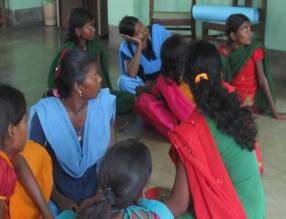

 After another round of games we got them into
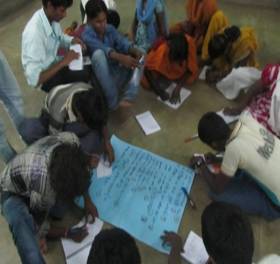
smaller groups to do an activity on “rights and discrimination”. Starting with
word association they have with rights and then with discrimination we gave
them a set of old newspaper and asked them to make their own news paper of
“rights & discrimination”. Next 15 minutes in smaller groups all of them
took our clips relevant to them and made the newspaper. All of them were
displayed and we asked groups to explain it to each other and ask questions
about how any picture/text signifies rights or discrimination to them.
 When we took them to their rooms in the evening,
seeing them understanding their reality at that time indicated how far they
have come today in terms of their life experiences especially for girls.
- They
were not sure about using bed sheets,
- They
were startled with the toilet flushing
- They
were not willing to stay alone or just 2.

Day 2
Morning
started early as Munna and Upendra lead a games session.
We
repeated all the games played on day one. While introducing some new games we
also shared with them “how to introduce games while facilitating a session”.
Kamlesh-
I have so many questions about my identity, caste system and why we are
called the 'lowest caste". If I study Sanskrit and start doing all
rituals I will be treated as higher caste or an equal. If so I will become a
Sanskrit scholar.
Kamlesh loves to study (read).
He had got some of his text books and some story books. At night he said he
studied up to 1 am. When asked him why he shared that in his village there is
no electricity. Since his room has power all night this is a golden chance to
read when on bed. So he wants to make best of this opportunity.
|
In
the next play session we introduced some games of experiential learning that
are also related to classroom content.
In a conversation
with Swati, Kaushalya Devi shared how her elder daughter who had not come for
the training had stopped studying after 5th grade when she was
beaten by a stick in the school. Her younger daughter who has come for the
training goes to the school but when she took her elder daughter the school
refused her admission.
While
Tea break when Swati noticed Sanjay sitting in a corner and checked with him
what is going on in his mind. Sanjay shared about the facilities at the venue,
the food and training and expressed how he was reflecting on how far one can go
if one is educated.
 Stories – The objective of the session was to share
stories of different ASF members and Poonam so the participants can see the
possibilities in their lives and look ahead.
 Amarjeet spoke about his journey talking about
how he faced discrimination and his struggle and what he is able to achieve
today.
Poonam
spoke about her struggle as a girl and how she had to come to hostel to escape
'child marriage'
Ashok
of Jamui also spoke about his struggle and how being in ASF has helped him. He
also talked about importance of ASF.
Ranvir
of Begusarai also shared his journey.
Participants
listened with rapt attention and when we asked them for their reaction some
boys did share their feelings.
 Rakesh talked
about how coming to the training has been a success as they are opening up and
able to speak their mind.
Shailendra
talked about how everyone he has heard has gone through the struggle and has
achieved something.
Kamlesh asked
some basic questions starting from “did the caste system arrive from above or
is it a creation on ground”, if it is arrived from above why can't we conduct
our own worships. He also shared that he has a 'pitara' of questions when Swati
suggested that he keep his questions and ask them when the time comes.
 Girls
did not feel comfortable to share their impression though we saw some queries
in their eyes. We didn’t feel it right to put pressure on them.
Upendra
shared his impression about cast system sharing how Britisher's left a power
structure that higher casts have appropriated. Kamal later on added about the
cast system based on “manu smiriti”
There
were also talks about need for being organized to ask for our rights. We shared
with them that on the last day of training we will talk about Bihar Ambedkar
Students Forum (BASF) so that they can go back in their communities and
establish their own ASF.
Anita:
She has the potential to be a leader. When I asked here where she learnt so
much from. She shared that she was in a hostel till 5th grade. That’s where
she learnt all about life.
After
meeting Poonam from Nari-Gunjan, Anita has found her calling. Poonam is her
best friend now and will help her get admission in 8th grade of her hostel. Anita
dreams to be a graduate.
|
In
the afternoon we showed them film based on Dr Ambedkar's life and struggle. It
is a 3 hour film and for some of them it was quite testing. After the movie we
asked them to make a note of questions they may have after seeing the film and
told them we will have a discussion on the last day and Satya will also be
there.
After revising some games we then moved
in to doing a mock session.
To
prepare for it we asked them to choose a game each that they will have to
conduct in the whole group. Once each one has selected a game we shared with
them how they can sequence their games for a play session.
Swati
then spoke to them about body language. Speaking in clear terms she cautioned
them about how they will have to act in a manner in the communities once they
start so that they do not invite negative attention.
 We
then formed triads for them to practice games with each other and told them
that tomorrow morning they will do a mock session where each one will conduct
their own game.
 Day 3
In
the morning all of them played games along with some ASF members. Mamta was not
well as she had thrown -up couple of times. We gave her a medicine and when I
asked her she shared that as today was suppose to be fasting she overeat, she
also said she has never gets sick.
Mock
session – post breakfast we started the mock session. Each one was responsible
to conduct a game.
Most
of them just said the name of the game and expected the game to start, we had
to constantly remind them that when they lead a game they are responsible for
it and have to decide when to finish.

Gudiya: She
remained silent on day one and day2. Would participate but would not look
into the eye and hesitate to come in the center to lead a game.
Day 3 of Gudiya- During the session on identity by Satya he
asked each one to make 1 promise to the group about what they will do-change
-start from today to make a difference to themselves or their community.
Gudiya suddenly found a voice. With lot of conviction she shared that her
brothers were sent to school while she was asked to cook Tiffin’s for them
and then take cows and goats for grazing. She felt terrible and one day
decided to stop cooking tiffin. Since then even her brothers stopped going to
school. Gudiya is angry with her parents who never ever sent her to school.
She wants to go start with knowing how to write her name. She shared that she
felt bad when she saw other girls making note of games in the training while
she couldn't.
|

As
soon as any game started, they got involved in playing and none of them
remembered to stay in control
They were
able to lead action songs, though it was challenging for some of them to
project their voice.
We
had to hand hold, walk along for some of them to gather the courage to
introduce their game
 Rakesh
who has more exposure and confidence among all of them while leading his game
missed out some rules
Mamta: She
was a quiet girl when she arrived. Very shy and would not look into the eye.
Mamta on day2 morning after 24 hours of KSM & Learning
ways of using bathroom at night: This was best night of my life. I
showered twice. Here clothes do not get wet as we can remove and bathe. We
can wear same clothes again.
For the 1st time I used white sheet and I felt like princess
when I slept in the soft bed.
Mamta on day 3: I am a dropout. I left school after 5th grade.
This was 2 years back. I want to go back to school. Can I go to Poonam's
hostel? I will convince my parents. I don't want to do labour work. I will
study and bring change in woman's life in my community.
Mamta on day 3 after Satya's session on identity: Swati didi
why don't you wear senduur?... No, you are not married. How can a married
woman stay like this (pointing at my “barren”
head, wrist and toes)?
Many girls were surprised which lead to a conversation on the fact that
why married men don't why to wear any symbol where as married woman have all
signs from head to toe.
Before leaving Mamta requested that she would like to study in
a hostel and we must come and talk to her parents about this.
|

Ramanti
who was relatively less participative and avoided any conversation with
facilitators choose to do Hariyali and despite being tentative used her voice
and I had to stand next to her and support her to finish her game
Sanjay,
Shailendra, Munna, Kamlesh, Anita, Sitpatia were confident in their demeanor
though they faltered introducing the game for lack of experience.
When
I asked them after the session about their experience of participating vs.
conducting most of them said they enjoyed both. In a way this was indicative of
them not being able to see participating and conducting as 2 different things.
Having no prior experience makes it difficult for them to see themselves as
leaders/decision maker.
When
asked if anyone was experiencing fear prior to leading their game, except for
couple of exception most of them said there was no fear. Yet when we observed
them while leading their games they were not able to give all instructions.
These two facts combined indicate they will learn quickly as they start
applying it.
Session on Identity by Satya
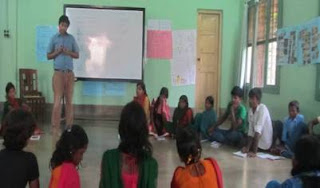 As Satya
started his interaction with asking them what are the challenges they face? The
session slowly moved into talking about identities. Some of the questions that
Satya offered them were:
Who calls us names harijan, dalit, mahadalit, manjhi?
Why do they call us by that name?
How did we know which identity (Caste) we have/we are from?
 How does our identity affect us?
Through
dialogue it came out that most of the time we acquire an identity that is given
and assume it to be true thus defining our realities.
Satya
then asked them 'if you have a choice what will you like to be known as?'
This got many people to change to different identity.
The
discussion moved into asking 'what is our weapon against all powerful
dominant cast who are keen to maintain status quo?'
There was some discussion around
“Constitution” as a common reference. We talked about how 'constitution' gives
us rights and remedies if there is a violation.
When
the discussion started about how we can change the system, some ideas were
- to draw
inspiration from Ambedkar
- to
educate and organize
- to help
people with a vision for future so they know where they are walking to
There
was a Question & Answer session as many of them had questions. Some of
which were triggered by watching the film on “Ambedkar”.
In
response to what helped Ambedkar to go so far despite oppression?, Satya
built connection between the provision of Scholarship in the constitution and
how it eased Ambedkar to go for higher studies and that's how he made sure to
get it in the constitution.
There
was another question about poverty as an equalizer and when it was asked if
a poor Brahman and a poor Dalit are same?
Everyone was clear that it is not. Satya shared with them that when
it comes to cast other factors diminish.
It
was quite an enriching session and I believe that it helped everyone to build a
perspective. The fact that we had done an activity on “Rights and
discrimination” on day 1 in hindsight became more relevant as they were able to
connect.
Impromptu SONG Session- We asked Poonam
to sing the song she has sung in Delhi before we took a break for lunch. During
lunch Lakho talked to Swati and said she wants to sing also. She was one of the
quietest of the participants so it was a pleasant surprise when she asked to
sing.
Action Plan
 Satya
asked each participant to commit to one thing they will change, within them or
outside.
Most
of the people wanted to focus on education. One girl said about stopping early
marriage including herself. Another person said to stop child-labour practice.
What we did not see forthcoming despite
all our believe about Play for Peace having transformative power was the anger
that came to surface in girls when they said they want to go to school. Neetu,
Gudia, Ramanti, Mamta, Lakho, Basanti, and Kajal: all of them have dropped out
at some stage. On the first 2 day of the training the girls were very tentative
whenever education/going to school came up in any conversation. Most of the
time they were quite reluctant to express their opinion.
Yet!
They were experiencing.....learning and quietly trying to make sense of it.
When the conversation about change began some girls were still tentative about
speaking their mind. When they realised it is for real, they spoke about
wanting education and how parents have asked them not to.
Neetu
who would avoid eye contact with me (Agyat) called me close to her and said, “I
want to study, my parents have stopped me”.
Ranjana
also asked me to come close and whispered, “I also want to study”. These were voices that have never found ears,
and this made the whole training come alive.
The critical part was to ask everyone to think
of one thing they will like to change themselves, with support. The question
coming from wind of possibility swept away self-doubts and brought the concerns
to surface.
Satya also
assured them and took commitment for them to study till graduation and that he
will do everything possible to support them.
Following
this we asked them to sit in tola groups to make a general action plan for each
tola. Since there was little time Satya asked them, “who are comfortable
conducting Play for Peace sessions on their own”. We then had 2 groups one was
of children who are relatively younger (11-14) and other young people. Munchun
who is younger (6th grade) chose to come in the facilitating group,
while Mamta who is probably 16 decided to opt out of it as she felt shy.
It
was decided that all of them will visit one tola every day and conduct play for
peace session there. Day and time was decided for each tola and Satya assured
them that their travel expense will be covered.
Five main action points
for training participants –
·
Forming ASF in Tolas.
·
Starting the process to setup ERCs and Libraries
in Tolas.
·
Conducting Khel se Mel in tolas each week
regularly one by one, each day.
·
Focusing on Manjhi children for facilitating
environment to study.
·
ASF members to guide self and others to study.
·
Arranging film screening in tolas.
Khel se male team who
will be visiting tolas to conduct KsM games
Jitendra/Sanjay/Saurabh/Sailendra/Munna/Pratima/
Anita/Kamlesh/ Rakesh
Schedule for doing KsM
Days
|
Tola
|
Time
|
Monday
|
Anjani
|
3:30
PM – 5:30 PM
|
Tuesday
|
Gosaimath
|
12:00
PM – 2:00 PM
|
Wednesday
|
Mahuabad
|
3:00
PM – 5:00 PM
|
Thursday
|
Tetari
|
3:00
PM – 5:00 PM
|
Friday
|
If
there will be any gap then KsM can be on this day
|
Saturday
|
Rohilachak
|
3:00
PM – 5:00 PM
|
Sunday
|
Punaichak
|
10:00
AM – 12:00 PM
|
What did we learn/relearn?
 We are Play for Peace since
2000. That has been the single most focal point of our lives since we began it.
The conviction of how it works as an enabler, a path-breaker, an attractor,
transformative has only grown with time. Yet some time when we see a fresh
group doubts surface, the stage-freight kind. So when the young people from
Dhanarua arrived their immediate body language, inhibition, apparent fear made
us wonder, how much headway we will be able to make with the group. The concern
was to not overwhelm them and not do anything that will reinforce their fear
about new experiences.
(I am glad our heart was at the right place)
 Agyat – in 13
years 99% of the time we have started our trainings with a set of games that
happen in circle including a name game. Here we chose a non-circle game, “walk
and stop” and for next 7-8 minutes we were just walking. What is the big deal
about walking.....precisely! No big deal! It worked, as John Dewey says, “The beginning of instruction
shall be made with the experiences learners already have.”
Walk and Stop not only started with what is familiar it also
helped them built familiarity with us, with the space and turned out to be very
appropriate. It opened them up for experiencing the training in a positive
frame of mind.
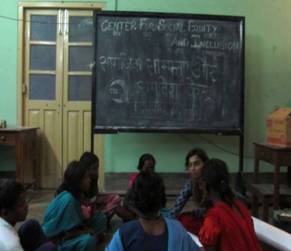 Swati – When I escorted
the girls to the rooms where they will stay overnight, it was intriguing to
watch their reaction as everything was first time for them. To have their own
bed, own sheets, own rooms were a unique experience. When I showed them how to
flush the toilets, they jumped back unfamiliar with the gush of water! My mind
was wrestling with thoughts about how even just being here for them is a
profound experience. How do we make the training content relevant for them? How
much will they be able to grasp? How do we plan so the 3 days are not so
overwhelming yet an adventure?
 To my utter joy on the second day when we started revising games,
girls were freely participating, singing as if that's the most usual act for
them or that they are in familiar surroundings. There and then I relearned
never to underestimate a group....or to say it differently “trust the process”
….Play for Peace!
….and yes, we are Play for Peace practitioners so we can endlessly
go about how it works. This time though we had a fresh pair of eyes, a new
heart who was part of the training, Kamal Naresh is the TISS intern with CSEI
who was helping us in the training. At the end we asked him to share his
impression & observation. So! This time for a change, here are the last
words (of this report).....
 Reflections about the three day training programme during 6th
Sep to 8th Sep
Dated:
9th Sep, 2013 by: Kamal Naresh
Observations:
·
It was observed that participants were quite
hesitant and only those took initiatives who had prior exposure with the people
(Facilitators) or the environment at large. There were very few who opened up
themselves even till the 2nd day.
·
The play for peace as a methodology for
inclusion was instrumental in giving a space to those who never had it and
there were many chances when the strategies planned in KsM games provoked
hesitant participants to take initiatives and helped them to gain confidence in
themselves.
·
I could see and feel how strong this method of
experiential learning is and how it is positive in every aspect of it. I
observed that it certainly helps people to learn new things in much simpler and
easier way.
·
On the critical issues of rights and
discrimination all the participants took active part. While explaining the
chart they had prepared they linked it with their idea of rights and the kind
of discrimination they face in and around their society.
Impressions:
·
I had an impression in the beginning that the
children would not be able to open up themselves in such a limited period of
time of three days. This was proved wrong as by the 3rd day I could see that
there was a notable change in children’ ability to express themselves.
·
The session on Rights and Discrimination
was done in such a manner that I could never imagine that it could be taught in
this way also. The issue was a critical one and something that is sensitive to
the participants as they all belonged to the most vulnerable, deprived and
marginalised section. This session and its application was quite helpful for me
as well as to understand and experience a method which is easy in practice and
successful in bringing learning results.
 ·
Post movie screening session also impressed me
as at the end of the movie, participants asked such a thoughtful question and
needed their answers seriously. I was surprised to see that the participants
had started thinking and raising questions. They all seemed concerned with the
issue and wanted to bring change in their present condition.
……a CSEI & Play
for Peace® initiative

 This YTH in Karol bagh, New Delhi is located in the center of a ‘Valmiki’ neighbourhood. Valmiki caste is called "bhangi" in a derogatory manner under the Hindu cast system and assigned the cleaning task under the caste system. . YTH is a community lead organization (CLO) that offers youth from marginalized community a space to connect, dialogue, learn and experience new possibilities.

 -Mussarat said give me a wall, I will make my own design. Nobody should touch. She used threads to create design. In her absence somebody put borders on her painting. Mussarat got very upset and emotional. She re-started her work on charts and did everything all over again the next day.

 I joined the Centre for Social Equity and Inclusion (CSEI works to promote equity and social inclusion for the socially excluded communities to build a more just and inclusive society) in 2010. My cousin worked in the National Campaign on Dalit Human Rights (NCDHR – is a campaign to protect and promote Dalit rights towards building a more just society). He helped me get a job here. What kept me in CSEI is the job profile. I got a sense of respect in CSEI. It was no more a cleaner's job. I would do bank jobs as well here.
 When I was asked to join the training team of Play for Peace- to go to Lucknow, I thought it’s a good opportunity to travel and know the world. I said yes. I could not believe that seriously somebody else would be appointed for my post and I would shift to program department.
 This change in my work profile is like a new platform for me and I see many possibilities of growth in me.


